Technology
Next-Gen Surveillance: How Wi-Fi Identifies Humans Without Cameras?

What if the way you move through a room was enough to identify you, no cameras, no devices, just Wi-Fi?
Yes, WhoFi pretty much does that!!!
A new surveillance breakthrough has emerged from Italy that redefines the boundary between convenience and intrusion.
Developed by researchers at La Sapienza University of Rome, WhoFi is a next-generation system capable of identifying and tracking individuals, not through cameras, microphones, or devices – but through the way their bodies subtly disrupt Wi-Fi signals.
As startling as it is innovative, WhoFi portrays a powerful shift in the way we perceive biometric identification and raises important questions about ethics, security, and personal privacy.
What Is WhoFi?
WhoFi is an AI-powered system that utilizes the natural behaviour of Wi-Fi signals to re-identify individuals based on their unique impact on those signals.
Unlike traditional biometric systems that rely on physical characteristics like fingerprints, facial features, or iris patterns, WhoFi operates invisibly.
It detects people by analyzing how their bodies alter the amplitude and phase of radio frequency waves as they move, or even stand still within the range of a 2.4 GHz Wi-Fi network.
The system does this by capturing Channel State Information (CSI), which records subtle fluctuations in signal behaviour caused by environmental interference. These minute changes become a kind of digital fingerprint, unique to each person.
A deep neural network trained on this data is then able to distinguish and re-identify individuals with a reported accuracy of up to 95.5% and a mean average precision (mAP) of 88.4%.
What sets WhoFi apart is its non-intrusive and device-free nature. There is no need for individuals to carry any gadgets, nor they are required to interact with any interface.
Simply entering a space with an active Wi-Fi signal is enough to allow the system to detect and identify them.
Additionally, WhoFi was trained and evaluated using the NTU-Fi dataset, which involved data from 14 individuals interacting across multiple access points. The use of this dataset validated WhoFi’s accuracy and adaptability in real-world conditions.
How Does WhoFi Work?
WhoFi’s functionality centres around its innovative use of Channel State Information (CSI) and machine learning. Here is a breakdown of its technical process:
1. Signal Interaction: Wi-Fi routers constantly emit signals throughout a space. When a person enters the environment, their unique body shape and movements alter the signal path, creating distinct patterns.
2. CSI Preprocessing: These patterns are captured as CSI data. Preprocessing steps such as amplitude denoising (e.g., Hampel filtering), phase sanitization, and synchronization correction help clean the data for analysis.
3. Deep Neural Pipeline: WhoFi functions on a two-stage deep learning architecture. The first stage is an encoder module that compresses high-dimensional CSI sequences into compact latent vectors. The second stage is a signature module that converts these into fixed-length biometric vectors normalized on a hypersphere.
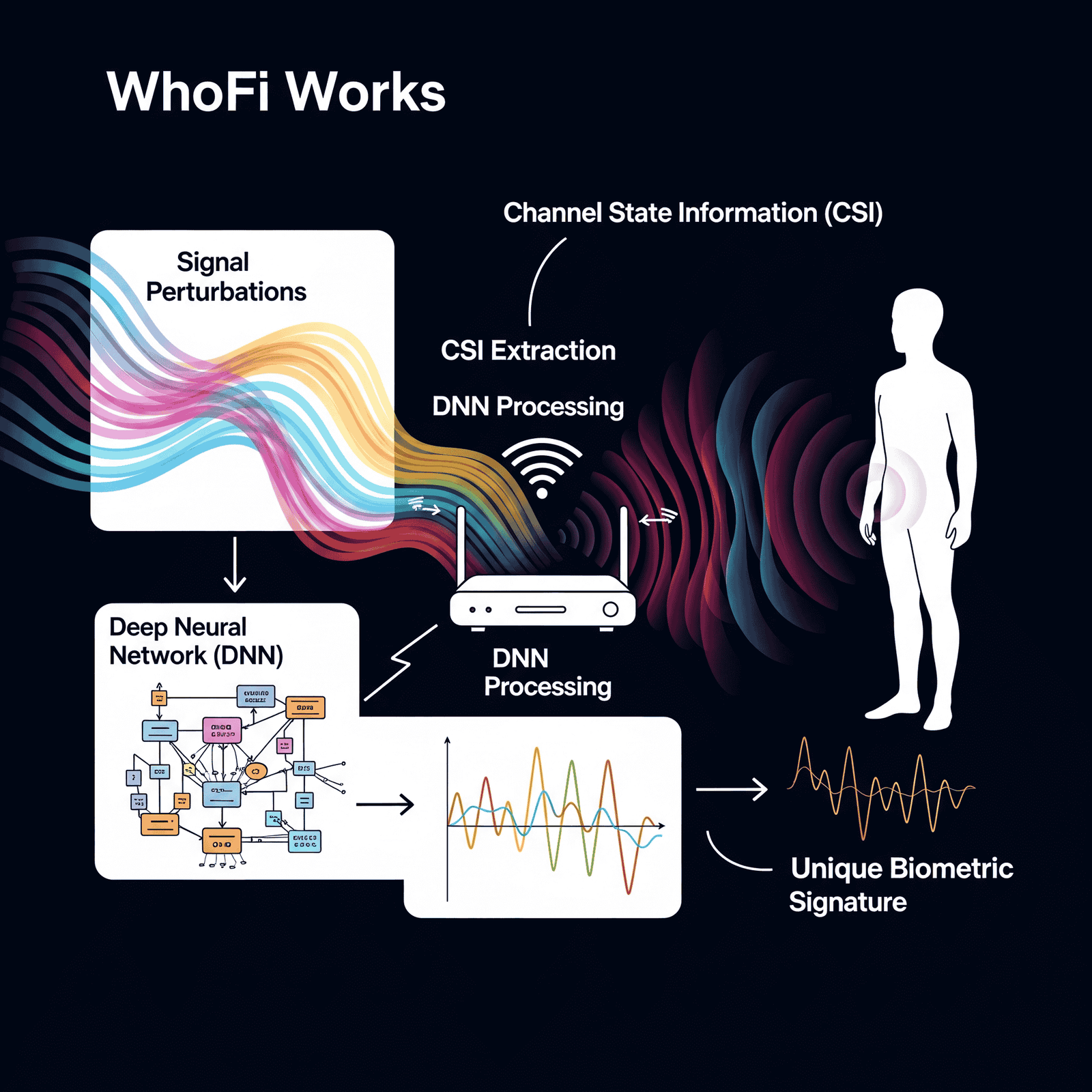
4. Transformer Superiority: The system tested multiple sequence modelling approaches – LSTM, Bi-LSTM, and Transformer, and found the Transformer architecture to be most effective. Its self-attention mechanism captures long-range dependencies in signal variations, providing better accuracy and generalization.
5. Training with In-Batch Negative Loss: A novel training method, in-batch negative loss, creates similarity matrices on the fly, enabling better differentiation between individuals without needing explicitly labelled data pairs.
6. Augmentation and Robustness: The model’s robustness is enhanced with strategic data augmentations like Gaussian noise injection, time shifting, and signal scaling, making it resilient to environmental noise.
7. Signature Matching: Once trained, WhoFi uses cosine similarity to match the new CSI vector against stored ones, enabling re-identification, even through walls or across different rooms.
8. Benchmark Results: Evaluated on the NTU-Fi dataset, WhoFi achieved a Rank-1 accuracy of 95.5% and a mean average precision (mAP) of 88.4%. These results establish a strong benchmark for wireless re-identification systems.
WhoFi’s real advantage is its ability to work silently through walls, unaffected by lighting or environmental conditions, while staying completely invisible to those it monitors.
How Does WhoFi Overcome Visual Limitations?

Traditional person re-identification (Re-ID) systems primarily rely on camera-based data matching individuals across footage using facial features, clothing, or gait.
However, in uncontrolled environments, these methods often falter. Variations in lighting, background clutter, camera angles, and occlusions can undermine accuracy, especially when appearance-based cues change.
WhoFi sidesteps these visual limitations by leveraging wireless signals instead of images.
Using standard Wi-Fi routers equipped with MIMO (Multiple-Input Multiple-Output) and OFDM (Orthogonal Frequency-Division Multiplexing) technologies, the system extracts Channel State Information (CSI), a detailed view of how radio signals are affected by the presence and movement of human bodies.
Each person’s skeletal structure, body mass, and movement style subtly disturb the Wi-Fi signal uniquely. Unlike cameras, Wi-Fi signals can pass through physical obstructions like walls, clothing, and even backpacks, enabling non-intrusive identification in low-light or complex environments.
Potential Applications of WhoFi

Although still in the research phase, WhoFi has vast potential across sectors:
- Security and Surveillance: Monitoring movements in secure areas without cameras. Ideal for low-light or visually obstructed zones.
- Smart Homes: Enabling presence-based automation without wearable devices.
- Healthcare: Passive monitoring of elderly or vulnerable individuals without intruding on their privacy.
- Retail Analytics: Understanding customer movement and behaviour without requiring apps or sensors.
- Access Control: Biometric-based entry systems that don’t require contact or badges.
Privacy Concerns and Ethical Implications
While the technology promises efficiency and innovation, it also poses significant privacy and ethical challenges:
- Invisibility: WhoFi operates without any visible hardware or user interaction. This makes it difficult for individuals to know when or if they are being tracked.
- Lack of Consent: People do not need to opt in or carry a device to be detected, raising serious concerns about surveillance without consent.
- Data Profiling: Though the system doesn’t capture personal identity directly, it can still construct detailed behavioural profiles based on movement patterns and presence.
- Potential Misuse: Because WhoFi operates using standard Wi-Fi routers, the technology could feasibly be deployed discreetly by individuals with sufficient technical expertise and malicious intent.
The researchers themselves acknowledge these concerns, noting that while the system does not collect conventional biometric data like faces or fingerprints, it still needs ethical and legal oversight before any real-world deployment.
Wi-Fi Sensing and What’s Next?
The development of WhoFi is part of a broader trend known as Wi-Fi Sensing, which has gained notable attention since the IEEE 802.11bf specification was approved in 2020.
Wi-Fi signals are increasingly being used for applications like fall detection, presence recognition, and gesture identification, without cameras or microphones.
While the intent behind such innovations may often be benign, their potential for abuse and surveillance cannot be ignored. WhoFi is a striking example of how ambient technologies, when paired with artificial intelligence, can dissolve the traditional boundaries between digital and physical surveillance.
In Short..
WhoFi shows how something as common as Wi-Fi can be transformed into a powerful tool for identifying and tracking people. Its potential is clear, in security, healthcare, smart homes, and beyond. But with that potential comes rising ethical concerns.
As Wi-Fi sensing starts moving beyond research labs and into real-world use, it’s up to technologists, policymakers, and all of us to make sure it’s handled with care. WhoFi isn’t just another tech innovation, it’s a clear sign that invisible surveillance is no longer a future concern.
FAQs
WhoFi is a Wi-Fi-based identification system developed by researchers at La Sapienza University. Unlike traditional biometrics that rely on physical traits like fingerprints or facial features, WhoFi identifies individuals by analyzing how their bodies subtly disrupt Wi-Fi signals. It doesn’t require cameras, microphones, or any device carried by the person being tracked.
Wi-Fi signals naturally interact with everything in an environment. When a person moves or even stands still, their body shape, size, and movement affect these signals in unique ways. WhoFi captures these changes using Channel State Information (CSI) and processes them with AI to create a unique “signature” for each person.
Yes. One of WhoFi’s biggest advantages is its ability to work in conditions where cameras can’t. It can detect and re-identify individuals even through walls, low light, or cluttered environments, because it relies on radio signal disruptions, not visual data.
No, WhoFi is still in the research phase. It was developed as an academic project and tested using controlled datasets like NTU-Fi. While it’s not yet commercially deployed, the technology shows strong potential for future applications in security, healthcare, smart homes, and retail analytics.
Since WhoFi can track people without their knowledge, it raises serious privacy and ethical concerns. There’s no need for consent or interaction, and the technology can be run using common Wi-Fi routers.